
The search for the best dog grooming clippers for thick fur UK started because I was sitting on my kitchen floor with a half-groomed dog, a pair of clippers that had completely given up, and enough loose fur floating around to knit another dog.
That wasn’t even the worst part. My Labrador cross had one side neatly clipped while the other looked like he’d lost an argument with a hedge. I ended up calling the groomer the next morning just to fix what I’d started. She smiled politely, but I could tell she’d seen this exact disaster before.
I’ve been grooming my own dogs for about nine years now. Not because I think I’m better than professional groomers—I definitely am not—but because regular appointments don’t always fit the budget, and some of my dogs have always been calmer at home.
Over the years I’ve learned that thick coats aren’t actually the biggest problem. Weak clippers are.
Best Dog Grooming Clippers for Thick Fur UK: What Actually Worked for Me
I made the mistake of buying a cheap set first.
The reviews looked decent enough, they claimed they could handle “all coat types,” and they were half the price of everything else. They managed about fifteen minutes before they started snagging on knots and getting warm enough that I kept stopping to check the blades.
My dog hated every second of it.
After that I stopped looking for the cheapest option and started paying attention to motor strength and blade quality instead.
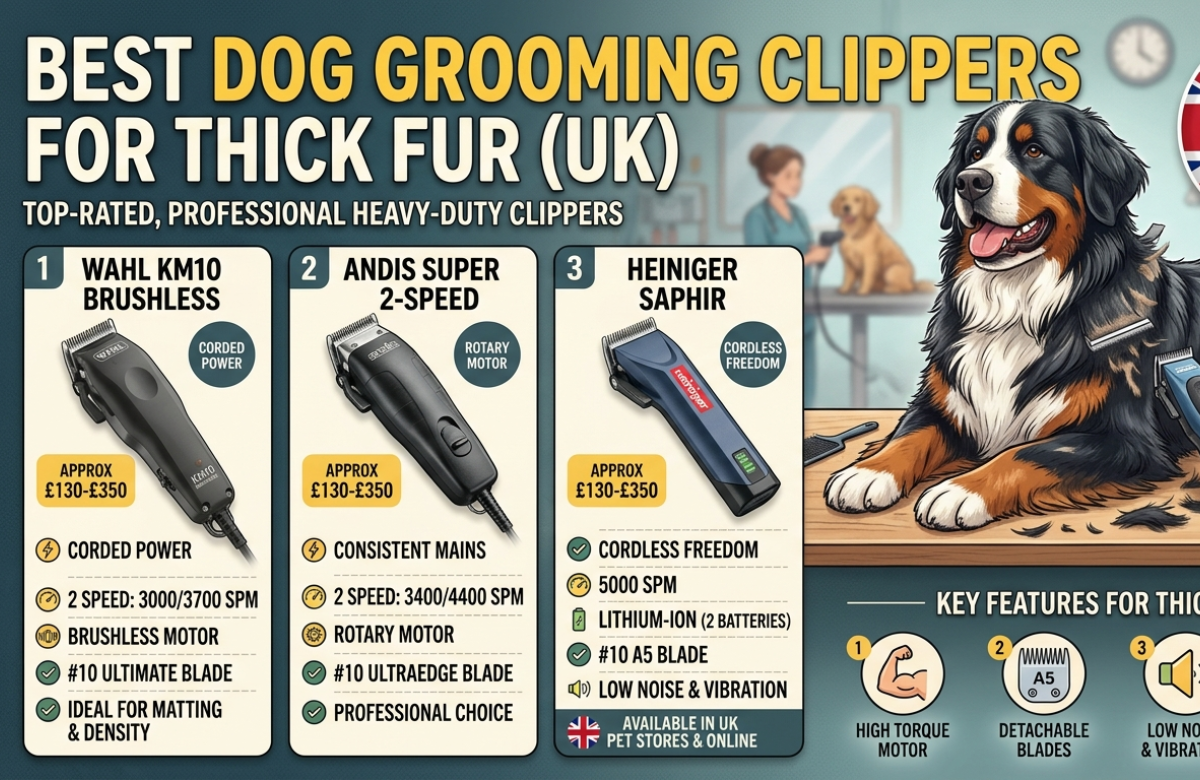
The clippers that have consistently worked best for thick coats have been:
- Andis AGC2 if you’re dealing with really dense double coats or a dog that needs regular full-body grooming. They’re heavier than some cordless options, but they don’t seem to struggle when the coat gets properly thick.
- Wahl KM10 if you want something that feels a little smoother in the hand during longer sessions. Mine has survived more accidental drops than I’d like to admit.
- Heiniger Saphir Cord (or the cordless version if that’s your preference) for dogs that get nervous around loud equipment. It’s noticeably quieter than some others I’ve tried.
None of these magically glide through badly matted fur, despite what some marketing photos suggest. If the coat is packed with tight mats, I still spend time brushing and carefully working through them first. Sometimes I simply cut around the worst areas rather than forcing the clippers through.
That lesson took me longer than I’d like to admit.
One afternoon I thought I could “just power through” a few stubborn tangles.
The clippers disagreed.
What Didn’t Work
Honestly, most of my mistakes came from trying to save money or time.
Cordless models with tiny motors sounded convenient, but some of them lost power exactly when I needed them most. Thick fur seems to expose weak motors almost immediately.
I also wasted money on blades that claimed to stay sharp forever.
They don’t.
If you’re clipping thick coats regularly, blades eventually become dull. Once I accepted that blades are basically a consumable item rather than a lifetime purchase, grooming got much less frustrating.
Another mistake was bathing immediately before clipping.
Clean dogs are great.
Completely fluffy, freshly washed, slightly damp dogs with tangled undercoats? Not so much.
Now I brush thoroughly first, bathe if needed, dry the coat completely, brush again, and only then start clipping.
It’s a slower process, but the clippers work far better.
A Few Things That Made Grooming Easier
I never try to finish everything in one sitting anymore.
When I first started, I’d think, “We’ll just get this done.”
My dog had other plans.
Now I’ll happily do the body one evening and tidy up the legs and feet the next day if he’s getting restless. Nobody hands out prizes for finishing in one session.
I also keep clipper oil within reach instead of somewhere sensible like the cupboard.
Stopping every ten or fifteen minutes to oil the blades sounds annoying until you realise how much cooler they stay.
One thing that surprised me was how much brushing affects clipping.
I used to think good clippers could compensate for poor brushing.
Turns out they can’t.
Even five or ten minutes spent removing loose undercoat beforehand makes the actual clipping smoother.
Things Nobody Tells You
Nobody really mentions how exhausting thick fur can be.
Not for the dog—for you.
By the time you’ve brushed, clipped, vacuumed twice, cleaned the blades, washed the towels, and somehow found fur inside your tea mug, you’re done for the day.
Also, dogs remember bad grooming experiences.
After my failed clipping attempt years ago, my dog became suspicious every time the clippers came out. It took several relaxed sessions with treats, breaks, and no pressure before he stopped inching toward the back door whenever he heard the motor.
That’s probably the biggest lesson I’ve learned over nine years.
A calm dog matters more than finishing quickly.
A Short Buyer’s Note
If your dog has genuinely thick, dense, or double-coated fur and you plan on grooming at home every month or so, I’d skip the cheapest clipper kits.
Paying more once hurt less than replacing underpowered clippers every year.
That said, something like the Andis AGC2 probably isn’t the right choice if you only trim tiny areas once every few months or you have a small dog with fine, silky hair. They’re built for heavier work, and that can feel like overkill for light touch-ups.
Sometimes a simpler, lighter clipper makes more sense.
FAQs
My clippers keep pulling my dog’s fur. Are they broken?
Not necessarily.
The blade could be dull, the coat may have hidden tangles, or the motor simply isn’t strong enough for thick fur. I blamed my first set for months before realising my brushing routine needed work too.
Is cordless or corded better?
I’ve used both.
Corded models usually have more consistent power for really thick coats. Cordless ones are lovely if your dog moves around a lot, but I’d only buy one with a strong motor and decent battery life.
Do I need expensive clippers if I’m only grooming at home?
Not always.
But if your dog has a heavy double coat, buying very cheap clippers often ends up costing more because they struggle, overheat, or wear out quickly. Mid-range or professional models usually last much longer.
What if my dog absolutely hates being clipped?
Don’t force an entire haircut.
Spend a few days letting them hear the clippers without clipping anything. Lots of treats, short sessions, and stopping before they get stressed worked much better for us than trying to “get it over with.”
Anyway, if you’re standing in your kitchen surrounded by fur and wondering whether it’s you or the clippers, there’s a decent chance it’s the clippers. I spent far too long blaming myself before I figured that one out.